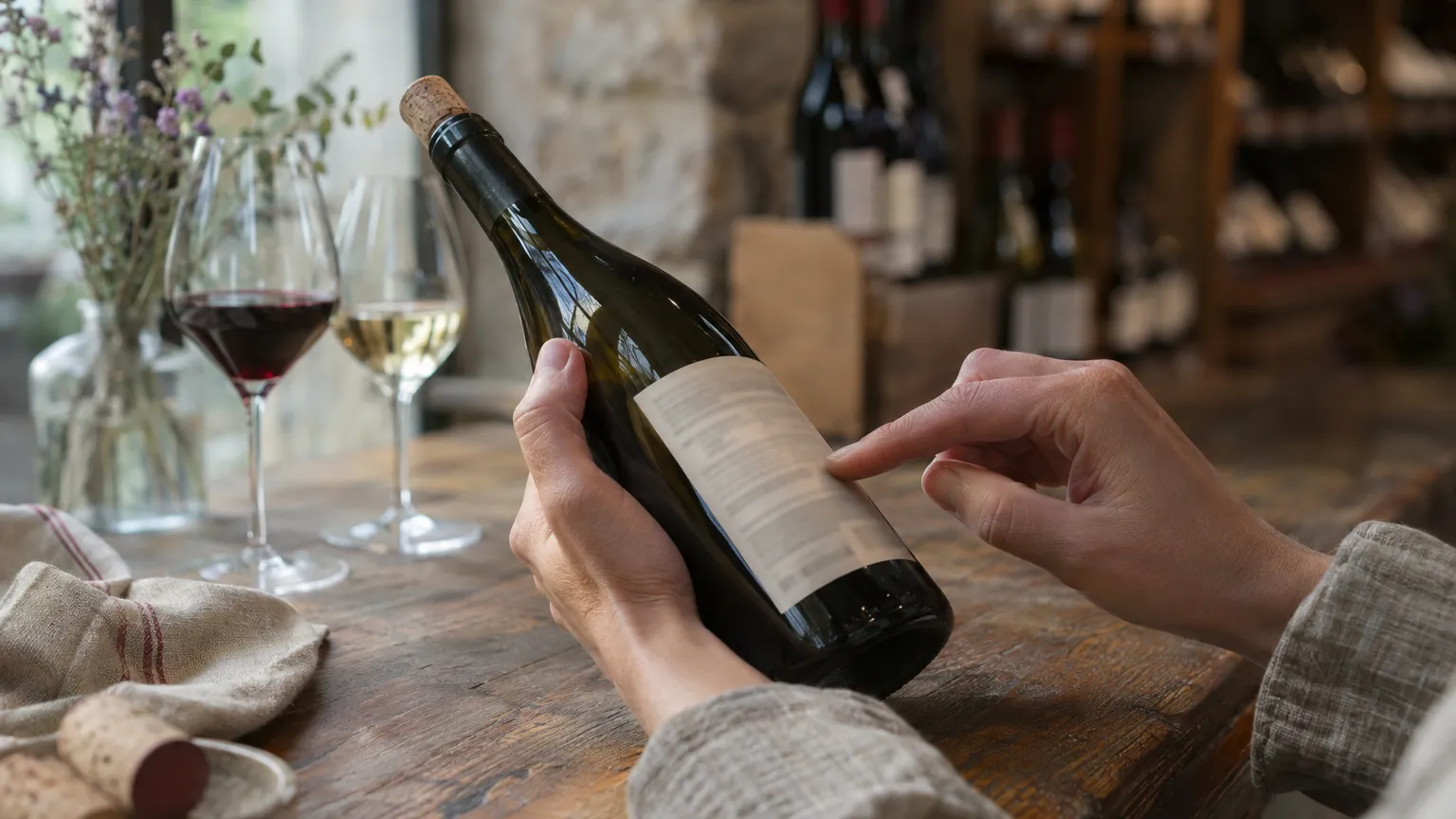
To read a wine label, first look for the appellation or indication of origin rather than the name in large print. Next, find the vintage and grape variety, if they appear on the bottle. Turn it around to check the alcohol content, volume, and identity of the bottler. These details describe the wine; none gives it a quality rating.
Key takeaways
- “Chablis” is an appellation; “chardonnay” is a grape variety. A cuvée name, on the other hand, does not guarantee where the grapes come from.
- AOP, IGP, and Vin de France indicate where the grapes come from, from the most specific area to the broadest.
- The vintage and grape variety are generally optional. Alcohol content and volume are mandatory.
- “Grand cru” and “Premier cru” are regulated; “Vieilles vignes” and “Réserve” are not regulated in France.

- Estate name
- Cuvée name (optional)
- Appellation
- “Appellation contrôlée” designation (AOC or AOP)
- Vintage (optional)
- Bottler
- Volume
- Alcohol content
- Sulfites
- Pregnancy warning symbol
- Lot number
- Barcode
- Ingredients and nutrition information (code)
How do you tell the appellation from the cuvée name?#
On a French bottle, look for the wording “appellation d’origine contrôlée” (AOC) or “appellation d’origine protégée” (AOP). The geographic name accompanying it identifies the appellation: the grapes come from a defined area and the wine meets a set of production rules. For an AOP, all the grapes come from that area. For an indication géographique protégée (IGP), the minimum is 85%.
The estate name identifies the producer. The optional cuvée name distinguishes one wine from the others it makes. An estate can therefore offer two cuvées under the same appellation. If you are choosing between these two bottles on a store shelf, the cuvée name will help you find the one you chose again.
AOC, AOP, IGP, Vin de France: what does each designation guarantee?#
These designations indicate where the grapes come from and which rules were followed in making the wine. They do not rank wines by quality: a Vin de France can be excellent, an AOP disappointing. They do, however, tell you what to expect from the bottle.
| Designation | Origin of the grapes | What it guarantees |
|---|---|---|
| AOC or AOP | 100% from the appellation’s defined area | A set of production rules covering permitted grape varieties, yields, growing practices, and winemaking. AOC is the French name, AOP the European name: both refer to the same thing. |
| IGP | At least 85% from the indicated area (for example, Pays d’Oc) | Production rules that are more flexible than those of an AOP, with a wider choice of grape varieties. |
| Vin de France | Anywhere in France, from one or more regions | French origin, without a specific region. The grape variety and vintage may be stated. |
| Vin de l’Union européenne | Several European Union countries | Only the wine’s European origin. |
To explore the appellations themselves, region by region, browse the French wine appellations.
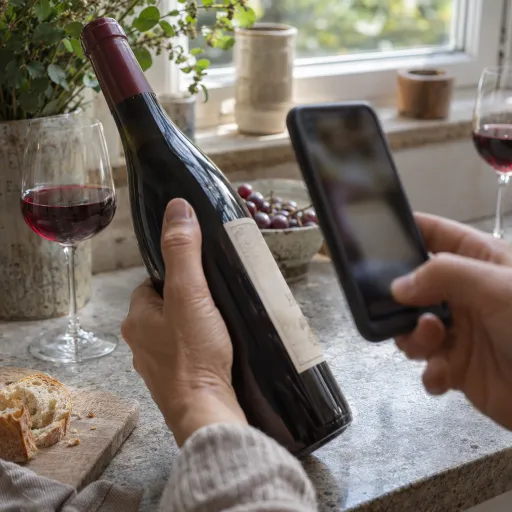
WITH VINIOU Snap a photo, and it’s in your wine cellar. Scan the label, Viniou recognizes the bottle instantly.What do “Chablis” and “Vin de France” reveal about the grapes?#
Compare two labels. On the first, you read “Chablis” and “2022,” but no grape variety. On the second, “Vin de France” and “Chardonnay,” but no year.

| What you’re looking for | Chablis 2022 | Vin de France, Chardonnay |
|---|---|---|
| Origin | The grapes come from the defined area of Chablis, in the Yonne department. | The grapes were harvested in France and the wine was made there. “Vin de France” does not specify the region where the grapes were harvested. |
| Grape variety | The Chablis production rules require chardonnay. The word does not need to appear on the bottle for you to know the grape variety. | “Chardonnay” is the only grape variety stated: at least 85% of the wine is made from it, but not necessarily 100%. |
| Harvest | 2022 is the vintage, not the year of bottling. | The label does not tell you when the grapes were harvested. |
When a label lists several grape varieties, together they account for the entire wine and are listed from largest to smallest proportion.
What does the year on the label guarantee?#
The vintage is the year the grapes were harvested. As a general rule, at least 85% of the grapes must have been harvested in the stated year. A Chablis 2022 bottled in 2023 is therefore still a Chablis 2022.
If there is no vintage on the label, do not assume it is a blend of several years. The producer may also have used grapes from a single harvest without stating the year. The vintage also helps you know when to open the bottle: our guide to identifying wines ready to drink starts with that year.
What do “Grand cru,” “Premier cru,” “Vieilles vignes,” and “Réserve” mean?#
These terms look similar on the label, but they do not carry the same weight. Some are defined by appellation rules; others are freely chosen by the producer.
| Designation | Regulated? | What it means |
|---|---|---|
| Grand cru | Yes | In Bourgogne, the highest tier in the classification of vineyard sites (climats), as in Chablis Grand Cru. In Alsace, one of 51 classified named sites. In Champagne, the highest-ranked villages. |
| Premier cru | Yes | In Bourgogne, vineyard sites ranked just below grands crus. The name of the climat often follows that of the village. |
| Grand cru classé | Yes | In Bordeaux, a château included in a classification, such as the 1855 classification. Not to be confused with the “Saint-Émilion grand cru” appellation, which is not a classification. |
| Vieilles vignes | No | No minimum vine age is set in France: each producer uses the term according to their own criteria. |
| Réserve, Grande réserve, Cuvée prestige | No | A marketing term used by the producer for their French wines. In Spain (Reserva) and Italy (Riserva), however, the term requires a specified aging period. |
Which mandatory details should you check on the back of the bottle?#
For a still wine sold in France, origin, alcohol content, volume, and identification of the bottler are among the mandatory details. They may appear on the back label or on the front. “12,5 % vol” indicates the proportion of alcohol by volume; “75 cl”, the amount of wine in the bottle.
The presence of sulfites must be declared above 10 mg/l, expressed as total sulfur dioxide. “Contient des sulfites” indicates that this threshold has been exceeded, not the exact amount. In France, a symbol or health warning also cautions against the risks of drinking alcohol during pregnancy.
For wines produced from December 8, 2023, onward, an ingredients list and nutrition declaration are mandatory. The list and detailed nutrition information may be accessible through a code on the label. The energy value and allergens that must be declared must remain readable on the bottle.
The back label also carries optional information: serving advice, food pairings, and a description of the wine. These come from the producer and are not checked in the same way as mandatory details. Finally, the barcode identifies the product at checkout. Its first digits indicate the country where the company registered its code, not where the wine was produced: a leading 3 does not prove that a wine is French.
What does “mis en bouteille au château” or “à la propriété” mean?#
The phrase “mis en bouteille par” identifies the party that bottled the wine or had it bottled on its behalf. That is not necessarily the party that grew the grapes. On the Vin de France in our example, the bottler’s location therefore does not tell you where the chardonnay was harvested.
“Mis en bouteille au château,” “au domaine,” or “à la propriété” tells you more: the wine was bottled at the estate where the grapes were harvested and made into wine. The term “à la propriété” is also permitted for a cooperative winery’s members’ wines. A merchant’s name followed by a town, on the other hand, indicates a wine purchased and then bottled by a wine merchant, which does not detract from its quality.
What label details should you keep to find the same wine again?#
“Chablis 2022” is not enough to find a bottle again: several producers may offer that vintage. Also note the producer’s name and the cuvée name, if it appears on the label.
With Viniou’s Label Scan, photograph the bottle’s label: the wine is recognized and added to your cellar, along with its appellation, grape variety, and vintage.
Sources: Commission Delegated Regulation (EU) 2019/33 on wine labeling, Regulation (EU) 2021/2117 (ingredients and nutrition declaration), Chablis appellation production rules (INAO), DGCCRF guidance on wine labeling.
Discover the Viniou app to manage your wine cellar.