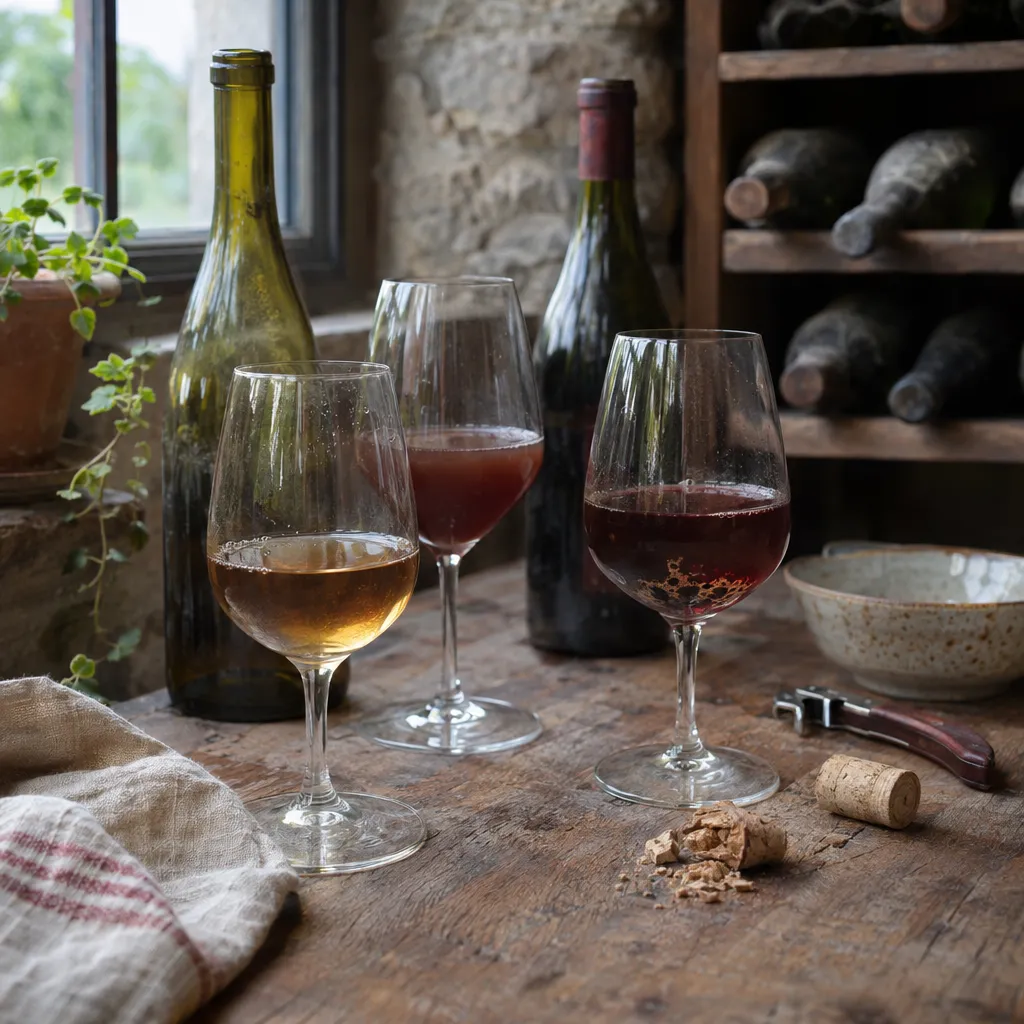
You can often spot a poorly stored wine before you even open the bottle: the fill level is too low, the cork protrudes from the neck, or there are sticky traces of wine under the capsule. Once opened, it smells of overripe apple, Madeira, cooked prunes, or vinegar, and its color has turned brown. An oxidized or heat-damaged wine can't be fixed, but not every flaw is caused by storage: some disappear after a few minutes of aeration.
The essentials
- Before opening: check the fill level, cork, and capsule.
- Oxidized, cooked, or vinegary: the wine has suffered from air or heat and can't be fixed.
- Smell of egg or a struck match: it's often reduction, which can dissipate in a decanter.
- Musty or wet cardboard smell: the wine is corked, and storage is not to blame.
How can you spot a poorly stored wine without opening the bottle?
The bottle speaks before the wine does. Three signs should alert you:
- The fill level has dropped. In a young bottle, the wine should reach the base of the neck. If it has dropped well below the shoulder, air has entered and the wine has probably begun to oxidize. In a wine over twenty years old, a slight drop is normal.
- The cork is protruding or sinking. A cork sticking out of the neck is a sign of heat exposure: the wine expanded and pushed the cork out.
- Wine has leaked under the capsule. Sticky traces or a capsule that no longer turns show that the wine has leaked, often after exposure to excessive heat.
The color, visible through the bottle, also offers a clue: a young white already turning amber, or a young red that has taken on a brick hue, has aged too quickly.
WITH VINIOU A wine expert’s guidance, effortlessly AI-powered tasting, storage, and aging advice.What are the signs when you open the bottle and pour the wine?
A cork soaked through to the top, dry and crumbly, or one that breaks into pieces is not a good sign. Next, trust your nose before your palate: most flaws are immediately apparent on the nose.
| Flaw | What you smell or see | Cause | What to do |
|---|---|---|---|
| Oxidized wine | Overripe apple, nuts, brown or orange color, faded fruit | Air entering through the cork (cellar too dry, bottle stored upright) | Can't be fixed; can be used in cooking if it hasn't turned vinegary |
| Cooked or maderized wine | Madeira, prunes, jam, pronounced alcohol | Heat exposure (car trunk, attic, summer without a cellar) | Can't be fixed |
| Vinegary wine | Vinegar, nail polish | Air and acetic bacteria, often in a bottle left open too long | Discard |
| Lightstrike | Cabbage, wet cardboard, in a white, rosé, or champagne | Clear bottle exposed to light | Can't be fixed |
| Corked wine | Mustiness, damp cellar, wet cardboard, muted fruit | Contaminated cork, not storage | Take the bottle back to the wine merchant |
| Reduction | Egg, struck match, rubber | Wine kept without exposure to air, not a storage flaw | Decant; the smell dissipates in a few minutes |
Two things often cause needless concern: sediment in an old red and small white crystals in a white wine (tartrates). They are natural and harmless: leave the bottle upright for a few hours, then pour gently or decant.
Is poorly stored wine dangerous?
No. An oxidized, cooked, corked, or vinegary wine is unpleasant, not toxic. You can safely taste it to judge. A wine that's simply past its prime can still be used in cooking, in a sauce or a bœuf bourguignon; a wine that smells of vinegar or mold cannot, as it would ruin the dish.
Wine that's too old or poorly stored: how can you tell the difference?
A wine that's too old has been well kept but is past its peak: it has lost its fruit and remains clean but thin, with no smell of Madeira or vinegar. A poorly stored wine has aged too quickly because of heat, air, or light, often showing cooked or oxidized aromas while still young. In both cases, the solution going forward is the same: know when to open each bottle and keep it in good conditions.
How long does an opened bottle keep?
Re-corked and refrigerated, including reds: two to three days for a white, rosé, or light red, three to five days for a structured red, and one to two days for a sparkling wine with an airtight stopper. Sweet and fortified wines last longer, from one to several weeks. Beyond that, the wine oxidizes and then turns vinegary.
How can you prevent it from happening again?
Good storage comes down to a few figures: a stable temperature around 12 °C, 60 to 80% humidity, darkness, minimal disturbance, and bottles stored on their sides. You'll find all the details in our guide to storing wine properly.
To make sure you don't miss the right time to open a bottle, Viniou provides storage advice for every wine in your cellar. With Premium, it also shows you when to open it, from youth to peak maturity, with a reminder at the right time.
By Arnaud Cariou, founder of Viniou
Article written on 11/23/2026