


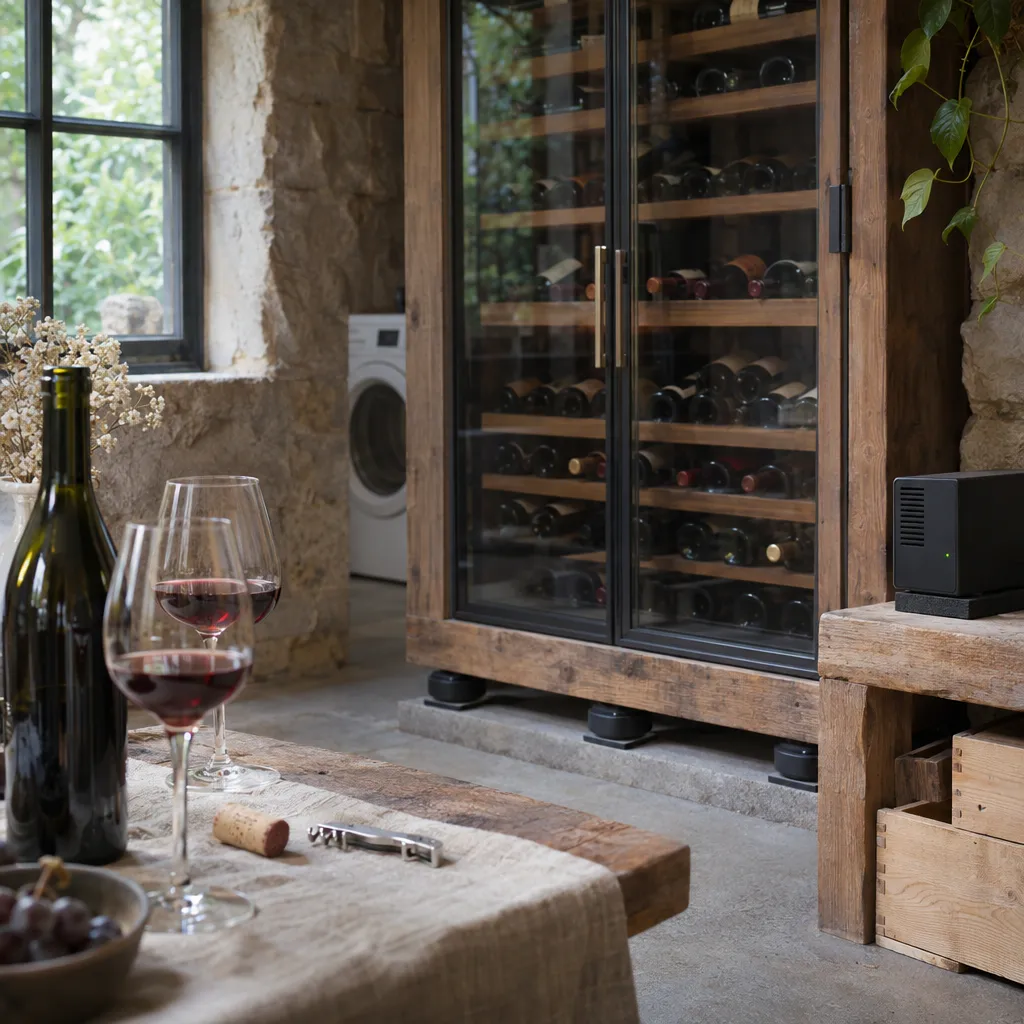
To protect a wine cellar from vibrations, keep it away from running appliances, place it level on a stable floor with vibration-damping pads, and handle the bottles as little as possible. This matters most for wines intended for aging and older vintages, whose sediment can be stirred back into suspension. For bottles you'll drink within a year, a few common-sense precautions are enough.
Key takeaways
- Vibrations stir up sediment in aged wines; their effect on aging has been little studied.
- The main sources are washing machines, dryers, boilers, compressors, and nearby traffic.
- A wine fridge should sit level on a hard floor, without touching the wall or another appliance.
- The most common source of jostling is often a hand searching for a bottle.
What do vibrations really do to wine?
The best-established effect is mechanical. Over the years, an age-worthy red wine forms a sediment of tannins and pigments that settles on the bottom or side of the bottle. Repeated jolts stir it back into suspension: the wine becomes cloudy and tastes bitter if served that way.
Beyond that, it's worth being cautious. A few studies suggest that strong, continuous vibrations alter certain compounds in wine, but they involve levels far higher than those found in an ordinary home. In practice, a wine intended for long-term aging benefits from being left undisturbed, while a wine drunk young won't suffer from being stored in a wine fridge near a refrigerator.
Where do vibrations in a wine cellar come from?
In a home, the usual culprits are motor-driven appliances: a washing machine on its spin cycle, a dryer, a boiler, a heat pump, or a water booster pump. Then there are outside sources: a road with heavy truck traffic, a railroad, or a subway running beneath the building.
There are also the small jolts of everyday life: a slamming door, a wooden staircase above the racks, or a floating floor that transmits every footstep to a wine fridge sitting on it.
WITH VINIOU A wine expert’s guidance, effortlessly AI-powered tasting, storage, and aging advice.Is a wine fridge compressor a problem?
Compressor-based wine fridges work like refrigerators: the motor starts and stops as cooling is needed. Manufacturers mount it on rubber supports, known as vibration isolators, which absorb most of the vibrations. A quality wine-aging fridge often adds wooden shelves, which dampen vibrations better than metal ones.
Thermoelectric wine fridges have no compressor and produce almost no vibration, but their cooling capacity is limited: they're suitable for smaller collections in a room that stays at a moderate temperature. Absorption wine fridges, which are less common, are also quiet. For more than a hundred bottles, compressors remain the standard.
How can you reduce vibrations day to day?
Set up the wine fridge properly
Adjust the feet so the wine fridge is perfectly level: a tilted appliance vibrates more and doesn't seal as well. Leave the space specified in the manual between the fridge and the wall, which also allows ventilation for the motor. Never place it directly against a refrigerator or washing machine, and don't put anything on top of it.
Use damping pads
Rubber or cork anti-vibration pads placed under the feet block much of the vibration transmitted through the floor. On a floating floor, a rigid board under the appliance distributes the weight and limits movement.
Choose the right location
In a fitted wine cellar, place the racks against the wall farthest from appliances and the street. Secure large racks to the wall so they don't resonate. Materials matter too: our article on wine cellar materials compares wood, metal, and stone.
| Source | What it produces | Solution |
|---|---|---|
| Washing machine, dryer | Strong jolts during the spin cycle | Move to another room or place the machines on a vibration-damping base |
| Wine fridge compressor | Low-level vibrations each time it starts | Level the fridge, place pads under the feet, and leave space between it and the wall |
| Boiler, heat pump | Continuous vibrations while heating | Place racks against the opposite wall, without contact with the appliance |
| Road, train, subway | Vibrations transmitted through the ground | Place racks against the wall farthest from the source |
| Handling | Bottles moved while searching for one | Know where each bottle is before opening the cellar |
How can you avoid moving bottles unnecessarily?
In a full cellar, finding one bottle often means taking out ten. This repeated handling is what jostles age-worthy wines most. The solution is to know where each bottle is before opening the door.
With Viniou, you can recreate your racks in a 3D cellar layout, with a designated spot for each bottle. You can go straight to the right slot and leave older vintages undisturbed at the back. For other storage conditions, including temperature, light, and humidity, see our wine storage guide.
By Arnaud Cariou, founder of Viniou
Article written on 11/23/2026