
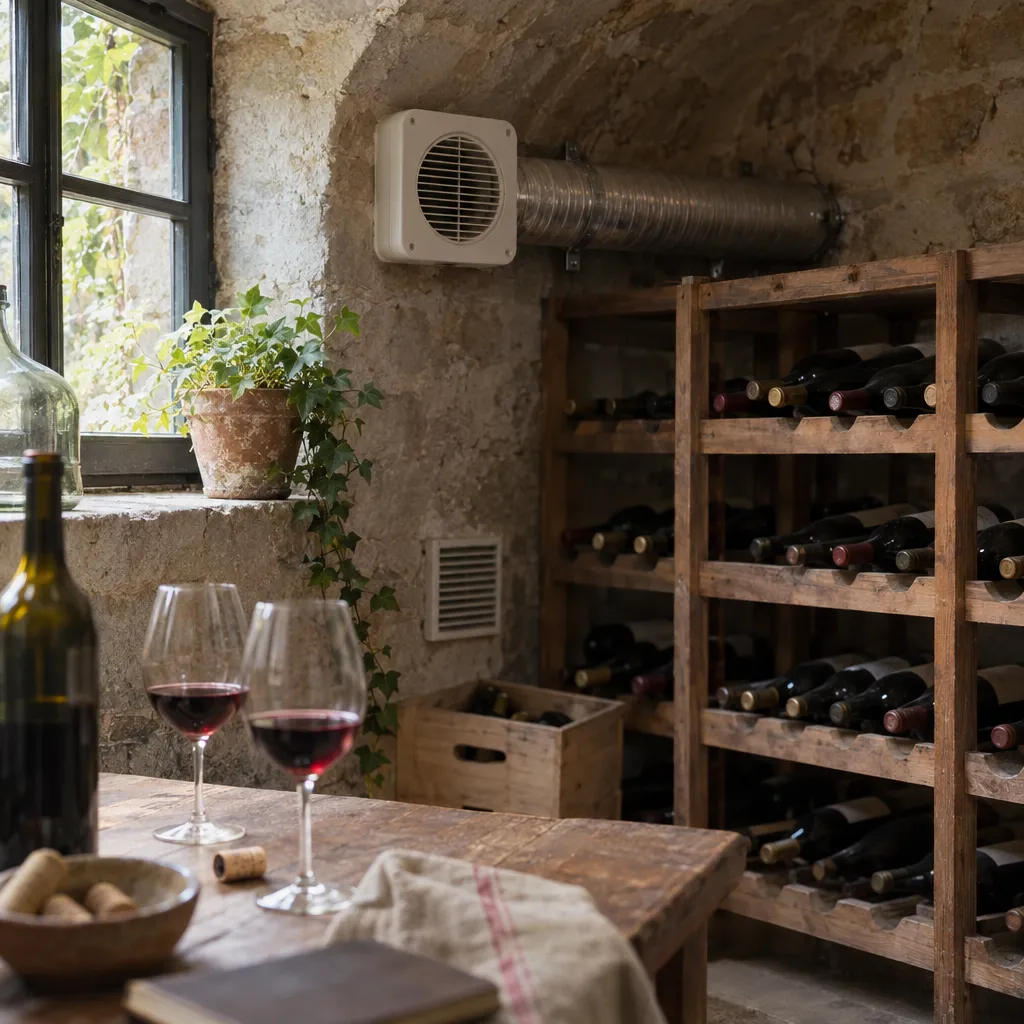
A wine cellar needs slow, continuous air exchange: enough to remove excess humidity and odors, but not enough to warm or dry out the space. In an underground cellar, two openings on opposite walls, one low and one high, are often sufficient. If the cellar remains damp or smells musty, a small exhaust fan controlled by a humidistat can solve the problem. When the temperature itself is too high, only a wine cellar cooling unit, which cools the air and regulates humidity, will truly do the job.
Key Takeaways
- The goal: slow air exchange without drafts or temperature fluctuations.
- Natural ventilation: a low air inlet and a high outlet on opposite walls.
- Cellar too humid: a low-flow exhaust fan controlled by a humidistat.
- Cellar too warm: a wine cellar cooling unit, not just ventilation.
Why ventilate a wine cellar?
Air that is never exchanged accumulates moisture and odors. Above 85% humidity, mold spreads across walls, racks, and labels, and musty odors can eventually seep through corks. Moderate ventilation removes excess moisture and keeps the air fresh without disrupting the temperature.
Beware of the opposite extreme: a strong draft dries out the cellar, causes temperature fluctuations, and dries out corks. The aim is barely perceptible air movement.
Signs of a poorly ventilated cellar
- A moldy or musty smell when you open the door.
- Condensation on walls or bottles.
- Black spots on labels and wooden racks.
- A hygrometer reading that stays above 85%.
What ventilation systems can you use in a cellar?
Natural ventilation
The traditional cellar solution: a low air inlet, preferably on the north side, and a high air outlet on the opposite wall. Cool air enters at the bottom, while warmer, humid air exits at the top, without a motor. Insect screens and adjustable vents let you reduce airflow in summer and during very cold weather. This is sufficient for most sound underground cellars.
An exhaust fan with a humidistat
When natural ventilation is not enough, a small, low-flow exhaust fan installed at the high outlet helps circulate the air. Controlled by a humidistat, it runs only when humidity exceeds a set level, such as 80%. Choose a quiet, low-power model: a bathroom exhaust fan, designed to exchange air quickly, would dry out the cellar.
A wine cellar cooling unit
A cooling unit designed for wine cellars cools the air, maintains a temperature around 12 °C, and regulates humidity. It is the solution for a cellar set up in a room or basement that gets too warm in summer. It costs more upfront and uses electricity, but it is the only system that truly solves a temperature problem. An ordinary household air conditioner is not suitable: it rarely cools to 12 °C and dries out the air.
A dehumidifier
For a sound cellar that is too humid, an electric dehumidifier set to around 70% complements natural ventilation. It does not exchange the air, so it is not a substitute for ventilation.
Comparison chart
| System | Best for | Advantage | Limitation |
|---|---|---|---|
| Natural ventilation | Sound underground cellar | Free, no maintenance | Depends on the weather |
| Exhaust fan with humidistat | Damp cellar, musty odors | Runs only when needed | Does not cool |
| Dehumidifier | Sound but overly humid cellar | Easy to install | Does not exchange the air |
| Wine cellar cooling unit | Cellar too warm in summer, converted room | Regulates temperature and humidity | Cost, energy use, installation |
How can you check that ventilation is working?
A thermometer-hygrometer that records minimum and maximum readings, checked weekly, is all you need: the temperature should stay between 10 and 14 °C with gradual changes, and humidity between 60 and 80%. Our article on cellar thermometers helps you choose one, and our wine storage guide brings together all the key guidelines.
For your bottles themselves, Viniou's storage advice tells you how to keep each wine and when to open it.
By Arnaud Cariou, founder of Viniou
Article written on 11/25/2026