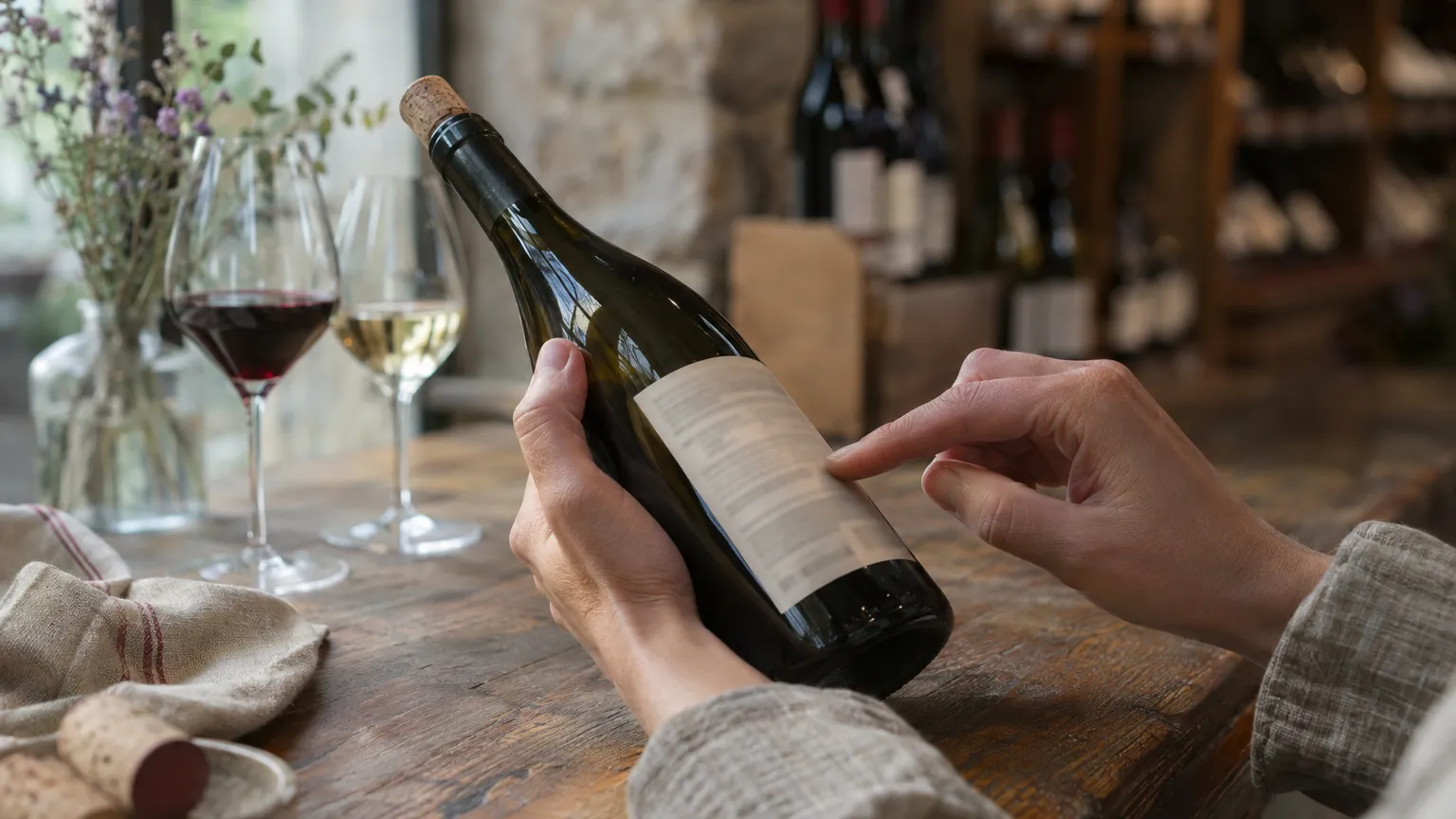
To read a wine label, start by looking for the appellation or indication of origin rather than the name in large print. Then look for the vintage and grape variety, if they appear on the bottle. Turn it around to check the alcohol content, volume and identity of the bottler. These details describe the wine; none of them assigns it a quality rating.
The essentials
- “Chablis” is an appellation; “chardonnay” is a grape variety. A cuvée name, on the other hand, does not guarantee where the grapes came from.
- The vintage and grape variety are generally optional. Alcohol content and volume are required.
- The address following “bottled by” is the bottler’s address. It does not, on its own, tell you where the vineyards are located.
How can you tell the appellation from the cuvée name?
On a French bottle, look for the phrase “appellation d’origine contrôlée” (AOC) or “appellation d’origine protégée” (AOP). The accompanying geographic name identifies the appellation: the grapes come from a defined area and the wine meets a set of production requirements. For an AOP, all the grapes come from that area. For an indication géographique protégée (IGP), the minimum is 85%.
The domaine name identifies the estate. The optional cuvée name distinguishes a wine from the others it produces. An estate can therefore offer two cuvées under the same appellation. If you are choosing between those two bottles on a shelf, the cuvée name will help you find the one you picked.
What do “Chablis” and “Vin de France” tell you about the grapes?
Compare two labels. On the first, you see “Chablis” and “2022,” but no grape variety. On the second, you see “Vin de France” and “Chardonnay,” but no year.
| What you’re looking for | Chablis 2022 | Vin de France, Chardonnay |
|---|---|---|
| Origin | The grapes come from the defined Chablis area in Yonne. | The grapes were harvested in France and the wine was made there. “Vin de France” does not specify the region where the grapes were harvested. |
| Grape variety | Chablis production requirements specify chardonnay. The word does not need to appear on the bottle for you to know the grape variety. | “Chardonnay” is the only grape variety listed: at least 85% of the wine comes from it, but not necessarily 100%. |
| Harvest | 2022 is the vintage, not the bottling year. | The label does not tell you when the grapes were harvested. |
What does the year on the label guarantee?
The vintage is the year the grapes were harvested. As a general rule, at least 85% of the grapes must have been harvested in the year shown. A 2022 Chablis bottled in 2023 is therefore still a 2022 Chablis.
If there is no vintage on the label, do not assume the wine is a blend of multiple years. The producer may also have used grapes from a single harvest without stating the year.
What required information should you check on the back of the bottle?
For a still wine sold in France, origin, alcohol content, volume and identification of the bottler are among the required details. They may appear on the back label or the front. “12.5% vol” indicates the proportion of alcohol by volume; “75 cl” indicates the amount of wine in the bottle.
The phrase “bottled by” identifies the party that bottled the wine or had it bottled on its behalf. This is not necessarily the party that grew the grapes. On the Vin de France in our example, the bottler’s municipality therefore does not reveal the region where the chardonnay was harvested.
The presence of sulfites must be declared above 10 mg/l, expressed as total sulfur dioxide. “Contains sulfites” indicates that this threshold has been exceeded, not the exact amount. In France, a pictogram or health warning also alerts consumers to the risk of drinking alcohol during pregnancy.
For wines produced from December 8, 2023 onward, an ingredients list and nutrition declaration are required. The list and detailed nutrition information may be accessible through a code on the label. The energy value and any allergens that must be declared must remain legible on the bottle.
What label details should you keep to find the same wine again?
“Chablis 2022” is not enough to find a bottle again: several producers may offer that vintage. Also note the producer’s name and the cuvée name, if it appears on the label.
With Viniou’s “Label Scan,” photograph the bottle’s label: the wine is recognized and added to your cellar.
By Arnaud Cariou, founder of Viniou
Article written on 11/21/2026