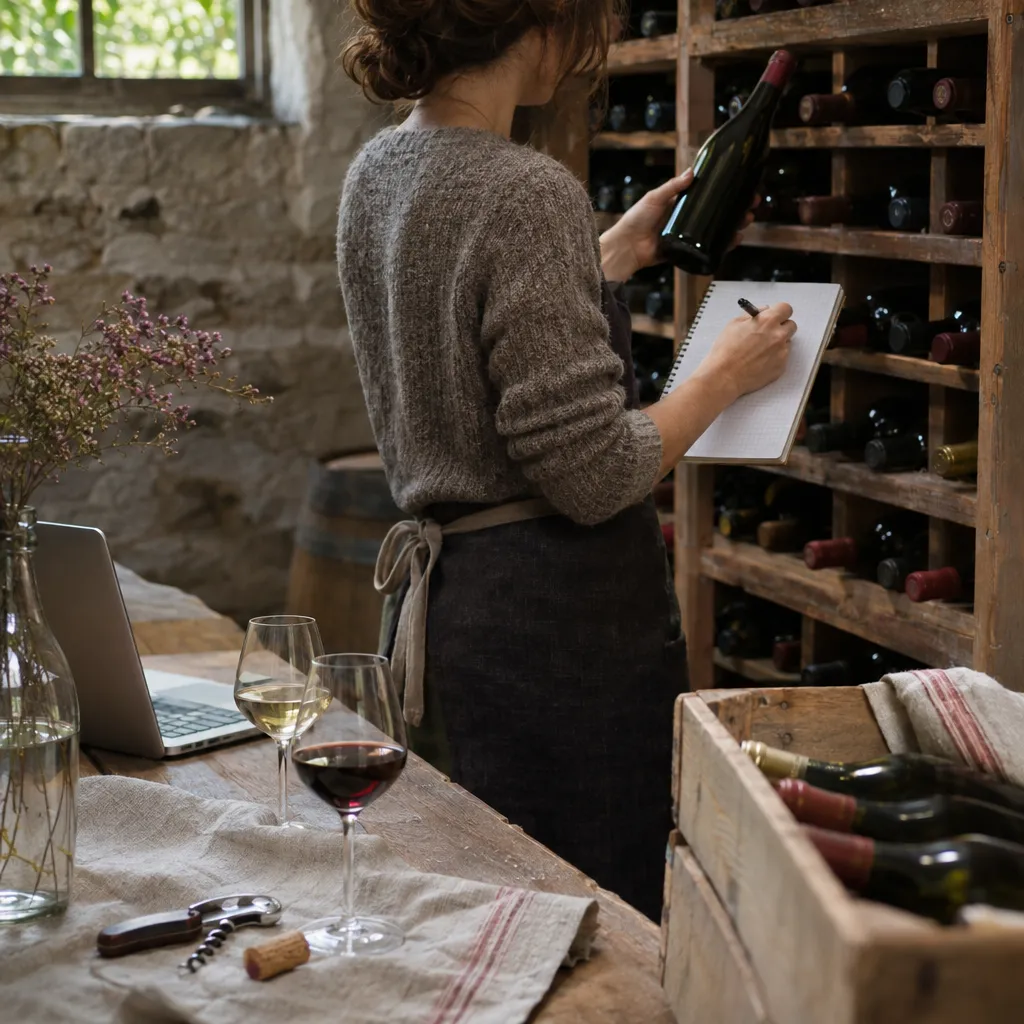
To inventory your wine cellar efficiently, work zone by zone, record a few consistent details, and log each bottle where it is stored. For each wine, record the name, appellation, vintage, quantity, and location. With a method and a fast tool, you can inventory a few hundred bottles in one or two evenings. The most important part comes next: recording every addition and removal to keep your inventory accurate.
Key takeaways
- Work rack by rack, without moving bottles from one zone to another.
- Record the name, appellation, vintage, color, quantity, and location of each wine.
- Purchase price and drinking window are useful extras for insurance and for making sure no bottle is overlooked.
- An inventory that isn't kept up to date becomes inaccurate within weeks.
Where should you start?#
Prepare your cellar. Before counting, number or name your racks and shelves: “rack A, row 3,” “top shelf.” These labels will help you record each bottle's location and find it later.
Work zone by zone. Start with one rack, record all its bottles, then move on to the next. Don't take everything out to sort by region or color: you'll lose track of where bottles belong and waste an entire evening. You can sort your collection afterward in your chosen tool.
Group identical bottles. Six bottles of the same wine and vintage make one entry with a quantity of 6, not six separate entries.
WITH VINIOU Manage your wine cellar with Viniou Know what’s in your cellar, where your bottles are, and when to drink them, on iPhone, Android, and computer.What should you record for each bottle?#
| Information | Essential? | Why |
|---|---|---|
| Wine or producer name | Yes | To identify it |
| Appellation and region | Yes | To choose and organize wines |
| Vintage | Yes | It determines when to open the wine |
| Color | Yes | To quickly find a white or red |
| Quantity and format | Yes | Bottle, magnum, half-bottle |
| Location | Yes | To find the bottle without searching |
| Purchase price and place of purchase | Useful | For insurance and reordering |
| Drinking window | Useful | To make sure no bottle is overlooked |
There's no need to copy the technical details of every wine: grape varieties, alcohol content, and tasting notes are easy to find when you need them. An overly detailed inventory never gets finished.
Notebook, spreadsheet, or app?#
A cellar notebook appeals to those who like a hands-on approach, but you can't search or sort it, and it becomes hard to read as corrections pile up. A spreadsheet lets you sort and filter, but you have to enter everything by hand, and it stays on your computer when you're in front of your cellar.
An app is the fastest option because it already knows the wines. In Viniou, you can add a wine by typing a few words from its name or photographing the label: the wine details fill in automatically, leaving you to enter only the quantity and location. If you already have an Excel file or another app, the cellar import brings everything over at once.
How do you keep an inventory up to date?#
An inventory quickly becomes inaccurate: a bottle opened one evening without being recorded, a case put away in a hurry, and three months later nothing matches. One rule is enough: record every addition and removal immediately, right there at the cellar. That's where an app on your phone makes a difference compared with a notebook or spreadsheet.
For purchases, Viniou can add an entire case by photographing the invoice (Premium). And to find a bottle, QR code labels attached to your racks take you directly to their contents. Once a year, a quick rack-by-rack count catches anything you missed.
What else is an inventory useful for?#
Making sure no bottle is overlooked. With each wine's vintage recorded, you know which ones to open first; Viniou Premium even shows each wine's peak drinking window.
Insuring your cellar. In the event of water damage, a wine fridge breakdown, or burglary, your insurer will ask for a list of bottles and their value. An inventory with purchase prices and the estimated value of your cellar is the best evidence.
Buying more wisely. You can see what's missing and what's sitting untouched, and avoid buying duplicates at the next wine fair.
For a faster option than a notebook or spreadsheet, create your wine cellar inventory in Viniou: adding a bottle takes just a few seconds. To save time on recent purchases, you can photograph a wine invoice. To move from a notebook to a file, see the free Excel cellar book offered by Viniou.
Discover the Viniou app to manage your wine cellar.