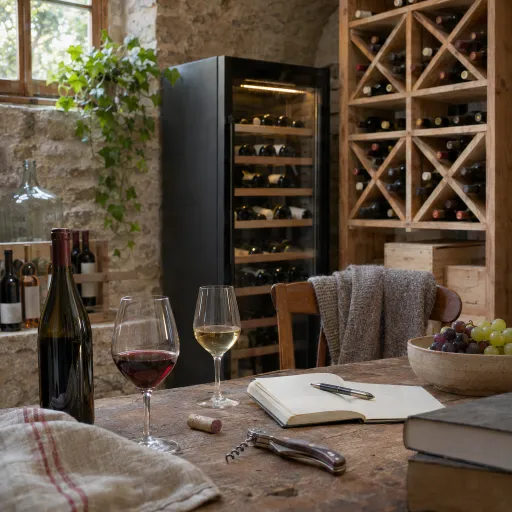
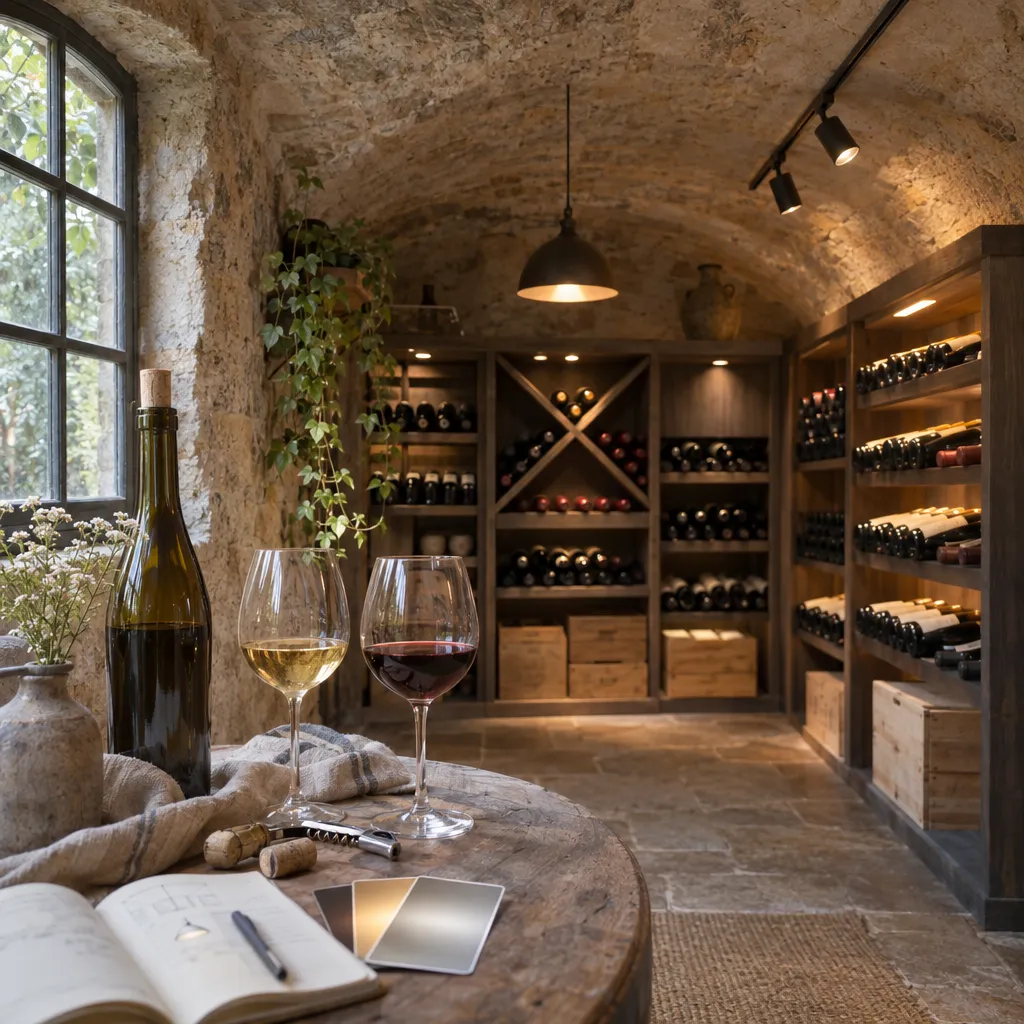
Good wine cellar lighting means warm white LEDs positioned to light the aisles rather than the bottles, and switched on only when you're there. They give off very little heat and almost no ultraviolet light. The rest is a matter of comfort: being able to read a label without a flashlight and giving the room the atmosphere you want.
The essentials
- Choose LEDs: little heat, very little UV, and a long lifespan.
- Aim for 2,700 to 3,000 K for ambiance and 4,000 K where you read labels.
- Light the aisles and work surface, not the bottles continuously.
- A motion sensor or timer prevents lights from being left on.
- Whites, rosés, and sparkling wines in clear bottles are most vulnerable to light: store them in the darkest part of the cellar.
What does light do to wine?
Wine contains riboflavin, a B vitamin naturally present in grape must. When exposed to ultraviolet and visible blue light, it reacts with certain sulfur-containing amino acids, such as methionine. This reaction produces volatile sulfur compounds, including methanethiol and dimethyl disulfide.
Winemakers have a name for the result: lightstrike. The wine smells of cooked cabbage, onion, wet cardboard, or rubber, and loses its fruit character. The fault does not disappear with aeration and is irreversible.
Light has a second, slower effect: it produces heat. An incandescent bulb or halogen spotlight placed near a rack raises the temperature of the nearest bottles, and repeated temperature fluctuations take a toll on the wine. Our wine storage guide details the temperature and humidity levels to aim for.
Which wines are most sensitive to light?
White, rosé, and sparkling wines are the most vulnerable. They have few tannins and pigments to absorb light, while the tannins in red wines act partly as a filter. A champagne or muscadet left under bright lighting for a few hours can already show signs of the fault.
The color of the glass matters as much as the wine. Clear glass, widely used for Provence rosés and some champagnes, lets almost all harmful light through. Green glass filters out some UV, but not blue light. Brown, or amber, glass offers the most protection.
What type of bulb should you choose for a wine cellar?
LEDs have become the preferred choice for good reason. They convert most of their energy into light rather than heat, which matters in a room you want to keep at 12 °C. Standard white LEDs emit almost no ultraviolet light, the rays that damage wine.
Other technologies have drawbacks. Incandescent and halogen bulbs produce a lot of heat and, for the most part, are no longer sold. Fluorescent tubes and compact fluorescent lamps emit some ultraviolet light, so avoid them near the racks.
| Lighting type | Heat | Ultraviolet light | For a cellar |
|---|---|---|---|
| LED | Very low | Almost none | The best choice |
| Compact fluorescent, fluorescent tube | Low | Some | Avoid near bottles |
| Halogen | High | Some, depending on the model | Avoid |
| Incandescent | High | Very little | Avoid, heats the room |
What color temperature is best for a wine cellar?
Color temperature is listed in kelvins on the packaging. Between 2,700 and 3,000 K, the light is warm and golden, creating the atmosphere of a vaulted cellar and flattering stone and wood. At 4,000 K, the light is neutral, making it easier to see the details on a label or the color of a wine in the glass.
Also check the color rendering index, listed as CRI. Above 80, colors look natural; above 90, they are rendered accurately, which matters if you taste in the cellar and assess a wine's color. Avoid colored LEDs as your main lighting: they look attractive in photos but distort colors.
Where should you place lights in a cellar?
Main lighting
Place it on the ceiling above the aisles and aim it toward the floor rather than the racks. The bottles will receive only brief, indirect light. In a small cellar, one or two ceiling fixtures are enough; in a long cellar, evenly spaced spotlights prevent dark areas at the far end.
Supplemental lighting
An LED strip under a shelf or above a work surface provides light where you read labels and record bottles taken out. Wall sconces directed toward the ceiling or a vaulted ceiling create ambiance without shining on the bottles.
Highlighting without exposing
If you want to illuminate a niche or a few large-format bottles, reserve this lighting for empty display bottles or red wines in dark glass, and don't leave it on all the time. Whites, rosés, and champagnes in clear bottles should remain in the darkest part of the cellar.
How can you protect bottles from light?
Cover windows and openings
A window or cellar vent lets in daylight, which is richest in UV. Block it out, or apply UV-blocking film to the glass. For a wine cabinet with a glass door, choose UV-treated glass and don't place it opposite a window: even when filtered, direct sunlight heats the bottles.
Shelter the most vulnerable wines
Place whites, rosés, and sparkling wines in the bottom rows, away from light fixtures, or leave them in their original wooden cases or cardboard boxes. Age-worthy reds in dark glass are better able to tolerate exposed spots.
Motion sensor, timer, or dimmer?
A motion sensor is the simplest solution: the light comes on when you enter and switches off after a few minutes without movement. Choose a model with an adjustable timer and position it so it can detect you at the far end of the cellar too; otherwise, the light may switch off while you're looking for a bottle. A push-button timer does the same job.
A dimmer lets you switch from bright light for organizing to soft light for entertaining. Check that your LEDs are labeled "dimmable" and are compatible with the dimmer, or they will flicker.
What electrical precautions should you take in a damp cellar?
A cellar at 70% humidity is not an ordinary room. Choose light fixtures rated at least IP44, and IP65 for LED strips installed near walls or in areas where water may run. The circuit must be protected by a 30 mA residual-current circuit breaker, and if in doubt, leave the installation to an electrician.
Good lighting saves you time when looking for a bottle, but knowing where it is saves even more. Viniou records each wine's location in your rack layout and offers QR code labels to print for racks and bottles: with light in the right place, your phone can scan them on the first try.
Sources: research by B. Haye, A. Maujean, and C. Jacquemin on lightstrike in Champagne wines (OENO One journal, 1977); Comité Champagne research on lightstrike.
By Arnaud Cariou, founder of Viniou
Article written on 11/23/2026