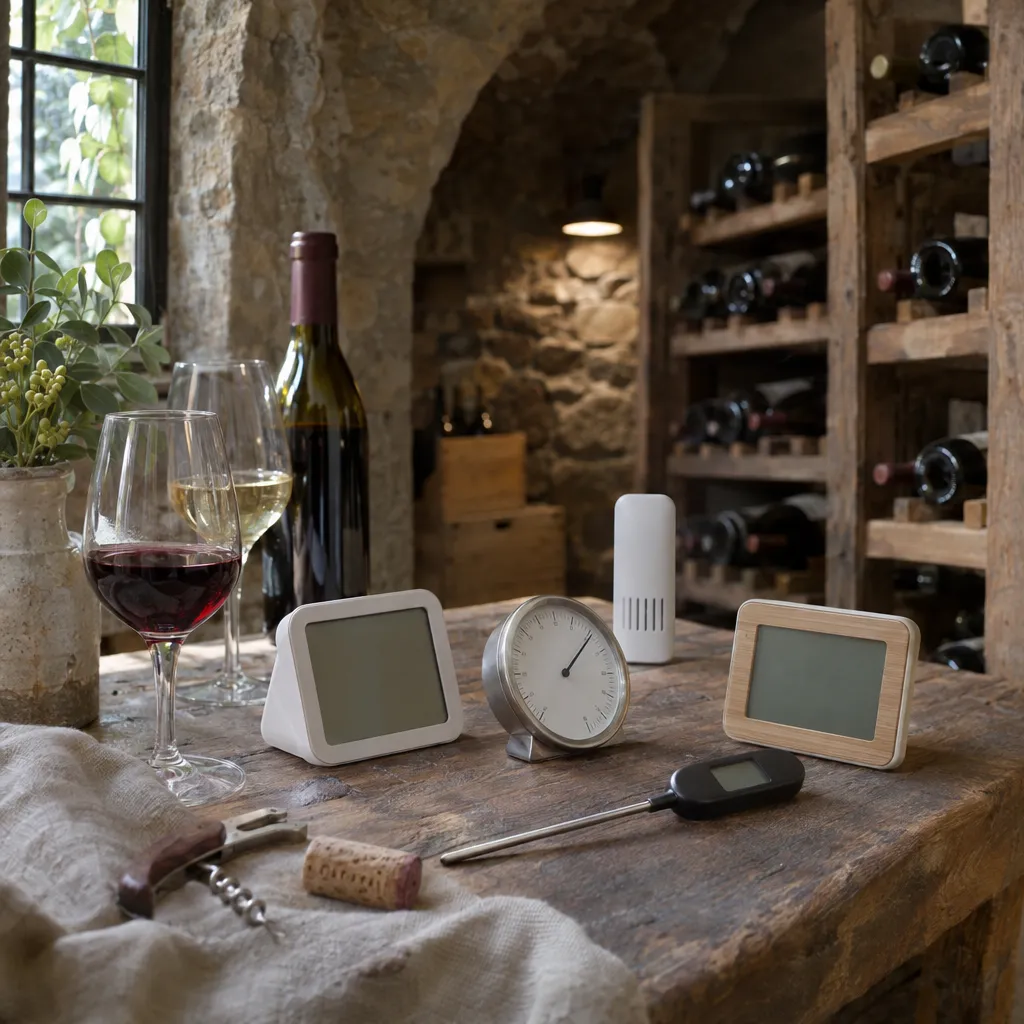
The best wine cellar thermometer is one that records the lowest and highest temperatures and also measures humidity. A digital thermo-hygrometer with min-max memory is sufficient for most cellars; a smart model that sends a history and alerts to your phone offers peace of mind when your cellar is far away or holds valuable wines. Place it in the middle of the cellar, at bottle height, and pay particular attention to fluctuations.
The essentials
- Choose a model that records minimum and maximum temperatures: a single reading tells you nothing about fluctuations.
- Measure humidity too, which should be between 60% and 80% in a cellar.
- Place it in the center, at mid-height, away from the door and walls.
- Aim for 10 to 14 °C, and above all, slow changes in temperature.
What types of thermometers are available for a wine cellar?
A basic thermometer, whether dial or alcohol-filled, shows the temperature at the moment you look at it. It tells you nothing about what happened overnight or during a heat wave, which is its main limitation.
A min-max thermometer records the lowest and highest temperatures since it was last reset. It is the most useful tool: check it every week and you can immediately see whether temperatures in the cellar are fluctuating.
A digital thermo-hygrometer also measures humidity, which is just as important as temperature for corks and labels. Most also record minimum and maximum readings.
A smart thermometer sends readings to your phone, keeps a history over several months and alerts you when a threshold is exceeded. It becomes indispensable for a cellar in a second home, or for monitoring an electric wine cabinet that could break down.
WITH VINIOU A wine expert’s guidance, effortlessly AI-powered tasting, storage, and aging advice.Comparison chart
| Type | What it measures | Approximate price | Best for |
|---|---|---|---|
| Basic thermometer | Current temperature | Under €10 | Temporary use, checking an electric wine cabinet |
| Min-max | Current, minimum and maximum temperatures | €10 to €20 | Any cellar, best value for money |
| Digital thermo-hygrometer | Temperature and humidity, minimum and maximum | €15 to €30 | Underground cellars, damp or dry cellars |
| Smart | Temperature, humidity, history, alerts | €30 to €80 | Remote cellars, valuable wines |
How to choose the right thermometer
- Accuracy: within half a degree is sufficient. Be wary of very inexpensive models, which can be off by two degrees; compare it with another thermometer on the first day.
- Min-max memory: essential for tracking fluctuations.
- Humidity: a feature well worth the few extra euros.
- Readability: a large, backlit display you can read without a flashlight in a dark cellar.
- Power supply: batteries that last a year or more, so it doesn't run out of power unnoticed.
Where should you place the thermometer in the cellar?
In the center of the cellar, at mid-height, where the bottles are. Avoid the door, exterior walls, floor and ceiling: the temperature there differs from the rest of the cellar. In a large cellar, warm air rises and cool air sinks: two thermometers, one at the top and one at the bottom, show the difference and help you store wines meant for aging in the coolest spot.
How to interpret the readings
| Reading | What it means | What to do |
|---|---|---|
| Between 10 and 14 °C, with slow changes | Ideal cellar conditions | Nothing |
| Up to 16-18 °C in summer, without sudden changes | Acceptable, wines will develop a little faster | Drink wines meant for aging a little sooner |
| More than 4 °C of fluctuation during the day | Cellar is poorly insulated or overventilated | Insulate, close openings during the day |
| Above 20 °C for weeks | Wines are aging too quickly | Move wines meant for aging, consider an electric wine cabinet |
| Humidity below 50% | Corks drying out | Add humidity: sprinkle water on the floor, use a tray of damp sand |
| Humidity above 85% | Mold, damaged labels | Ventilate, dehumidify |
Find all the key storage guidelines in our wine storage guide. And if the cellar has gotten too warm, Viniou's storage advice for each wine can help you decide which bottles to open without delay.
By Arnaud Cariou, founder of Viniou
Article written on 11/26/2026