

Organizing your cellar well means choosing one system and sticking to it, then making every location easy to identify without pulling out bottles. The most effective approach combines organization by drinking window, a label on each rack, and a tag on each bottle's neck. The rest depends on the size of your cellar and your habits.
Key takeaways
- Four ways to organize your cellar: by color, region, drinking window, or occasion.
- For fewer than 100 bottles, color is enough; beyond that, combine two criteria.
- Label the racks, not just the bottles: when bottles are stored on their sides, only the neck is visible.
- A QR code on each rack or bottle links its location to the wine's full details.
Which system should you choose for your cellar?
There is no single best way to organize a cellar, only one that suits how you drink. Before moving a single bottle, ask yourself what you look for when you head down to the cellar: a wine for a meal, a wine that's ready to drink, or a specific bottle.
By color
Reds on one side, whites on the other, with rosés and sparkling wines separate. It's the simplest approach, and it has a practical advantage: whites and sparkling wines, which are more sensitive to heat and light, can go on the lower, cooler rows. Beyond 100 to 150 bottles, it is no longer enough on its own.
By region
Bordeaux, Bourgogne, Rhône, Loire, Alsace, Languedoc: each region has its own section. This is the most natural system for those who know wine, as it reflects how they buy bottles and think about pairings. We cover it in detail in our article on organizing wines by region.
By drinking window
Put wines to drink within the year at the front and wines that need more time at the back or higher up. This system prevents a cellar's costliest mistake: a forgotten bottle that is past its peak. It does, however, require knowing how long each wine can age and moving bottles as the years pass.
By occasion
Everyday wines, wines for entertaining, and special bottles reserved for birthdays and anniversaries. Practical in a small family cellar, this system is still subjective.
WITH VINIOU Find a bottle in a flash A QR code to stick on, one scan, and it’s identified.How do these systems compare?
| System | Cellar size | Strength | Limitation |
|---|---|---|---|
| Color | Fewer than 150 bottles | Easy to see at a glance, no upkeep | Too broad for a large cellar |
| Region | 100 bottles or more | Intuitive for pairings | Uneven sections if one region dominates |
| Drinking window | Any size | No wine forgotten | Bottles must be moved each year |
| Occasion | Small cellar | Simple for the whole family | Subjective categories |
For a cellar of more than 200 bottles, the most reliable combination is to organize first by region, then by drinking window within each section: wines ready to drink at the front, wines to age at the back. For a rapidly growing collection, stock rotation becomes a consideration, which we discuss in our article on managing your cellar inventory.
How should you label your bottles and racks?
Rack labels
A label for each row or slot, attached to the rack frame, identifies the section and sometimes the wine. Choose a material that can withstand cellar humidity, typically around 70%: plastic, slate, or a laminated label. Number the rows and columns, for example A through F and 1 through 12, so that each bottle has a precise address.
Neck tags and labels
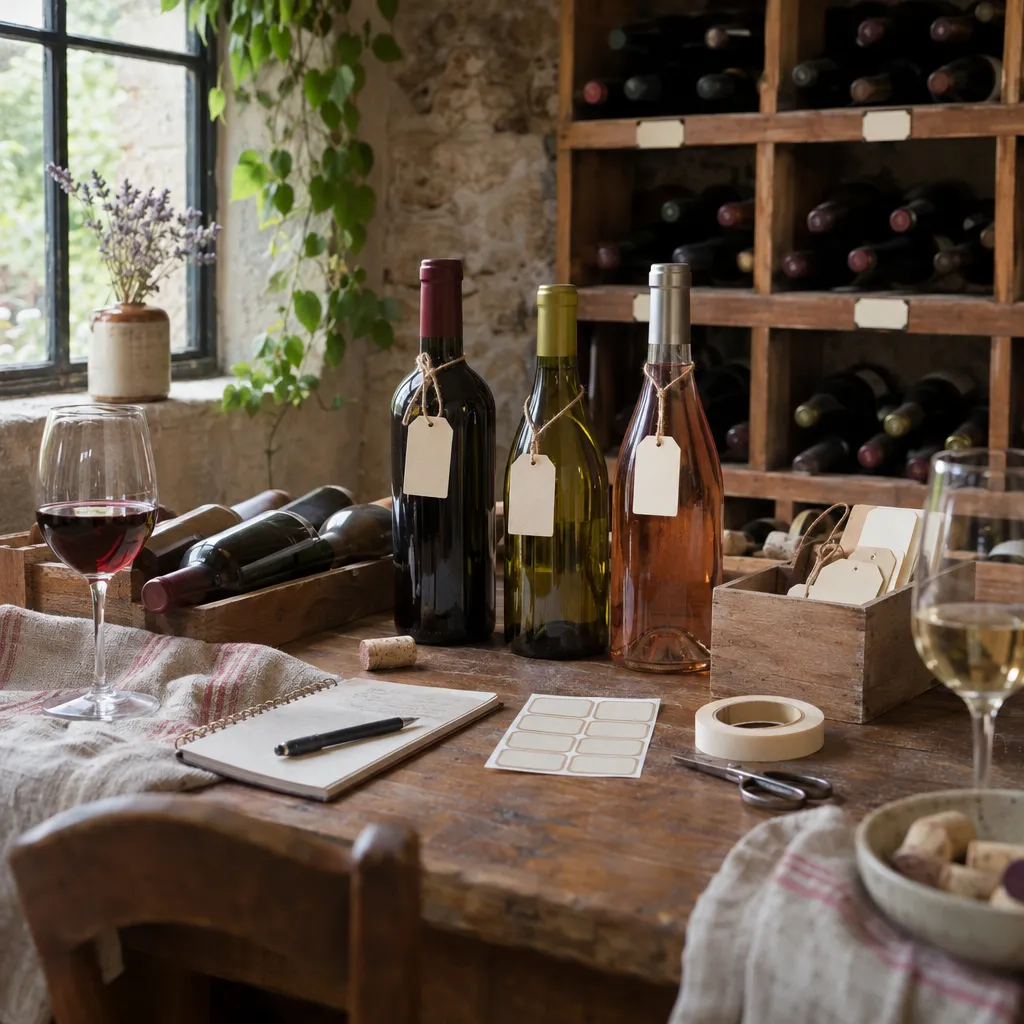
When bottles are stored on their sides, only the neck is visible. A tag hanging from the neck, with the wine's name, vintage, and drinking window, saves you from pulling out the bottle to read its original label. To preserve those labels, read our tips on protecting bottle labels.
QR codes
A handwritten label can never tell you everything. A QR code attached to the rack or hung from the bottle's neck takes you to the wine's full details when scanned with your phone. Viniou lets you print QR code labels for racks and bottles: a quick scan with your phone is all it takes to find the wine in your cellar.
How can you find a bottle without searching through your cellar?
Physical organization has a limitation: it answers only one question at a time. A cellar organized by region doesn't tell you which wines are ready to drink, and a cellar organized by drinking window doesn't tell you where your Bourgogne wines are.
That's where an up-to-date inventory complements your labels. In Viniou, each bottle is placed on the 3D layout of your cellar, rack by rack. Find a wine in your inventory and the app shows you its rack and position. With Premium, a list of wines ready to drink now supplements your own system, whatever it may be.
By Arnaud Cariou, founder of Viniou
Article written on 11/23/2026